
Decodo Review 2026: Pricing, Performance & Verdict

If you were using Smartproxy and recently noticed the name change, you are not alone. Smartproxy rebranded to Decodo in 2024, consolidating all its proxy and web data products under a single brand. The core infrastructure, pricing model, and support team remain the same — this is an evolution, not a replacement.
Decodo is a Lithuania-based proxy provider founded in 2018. Over seven years, it has grown into one of the larger residential proxy networks, offering 115M+ real-user IPs across 195+ locations, alongside ISP proxies, mobile proxies, datacenter proxies, and more recently a web scraping API.
This review covers every proxy type Decodo offers, with exact pricing tables, honest assessment of where it excels, and where the value proposition breaks down. If you are evaluating Decodo against Bright Data or Oxylabs, the final sections cover that comparison directly.
Quick Verdict
Rating: 4.7 / 5
Pros:
- 115M+ ethically sourced residential IPs across 195+ locations
- ISP proxies from premium ASNs (AT&T, Verizon, Orange) with 99.99% uptime
- Mobile proxy pool covers 10M+ IPs across 700+ carriers and 3G/4G/5G
- Datacenter proxies are among the cheapest at scale — $0.38/GB for 10TB
- 24/7 live chat support that actually responds quickly
- Based in Lithuania — outside Five Eyes jurisdiction
Cons:
- Pay-as-you-go residential rate ($8.50/GB) is expensive for casual users
- 14-day money-back guarantee has a usage cap — less than 20% of purchased bandwidth must be used
- Dedicated datacenter IPs are US-only
- Entry-level residential plans start at 3 GB, which limits low-volume testing
- X Browser (built-in antidetect browser) has been discontinued — you need a separate tool
What Is Decodo?
Decodo (formerly Smartproxy) is a proxy infrastructure company founded in 2018 and headquartered in Vilnius, Lithuania. The rebrand in 2024 brought together all the company's products — residential, ISP, mobile, datacenter proxies, plus the Site Unblocker and Web Scraping API — under one unified brand.
Being headquartered in Lithuania is worth noting. Lithuania is not part of the Five Eyes, Nine Eyes, or Fourteen Eyes intelligence-sharing alliances, which matters for users in privacy-sensitive industries.
At its current scale, Decodo serves both individual developers and enterprise teams. The platform includes sub-user management for agencies, a built-in antidetect browser, Chrome and Firefox extensions, and direct integrations with tools like AdsPower, n8n, LangChain, and an MCP Server. It is a more complete ecosystem than most proxy providers offer.
Proxy Products Overview
Decodo offers five main product categories. Here is a quick reference before we go into detail on each:
| Product | Pool Size | Best For | Starting Price |
|---|---|---|---|
| Residential Proxies | 115M+ IPs | Web scraping, market research | $3.75/GB (3 GB plan) |
| ISP Proxies | Premium ASNs | Account management, social media | $3.33/IP/mo (3 IPs) |
| Mobile Proxies | 10M+ IPs | Mobile app testing, social automation | $3.75/GB (2 GB plan) |
| Datacenter Proxies | 500K+ IPs | High-volume scraping, SEO | $0.60/GB (10 GB plan) |
| Site Unblocker | N/A | JavaScript-heavy sites, CAPTCHAs | $0.95/1K requests |
Each product runs on HTTP(S) and SOCKS5 protocols. All plans include access to the Decodo dashboard, proxy checker tool, and browser extensions.
Residential Proxies
Decodo's residential proxy pool is built on 115M+ real-user IPs sourced through an ethically operated peer network. Coverage spans 195+ countries, with targeting options down to country, state, and city level for most major markets.
Sticky sessions last up to 30 minutes, which is long enough for most account management and checkout automation workflows. Rotation is automatic by default, or you can control session persistence using the session parameter in the proxy string. Both HTTP(S) and SOCKS5 are supported.
These are a solid option for general web scraping, price monitoring, and market research. For the specific use case of finding the best rotating proxies, Decodo's residential pool is competitive on pool size, though Bright Data edges it on success rates against heavily protected targets.
Residential Proxy Pricing (pay per GB):
| Plan | $/GB | Monthly Total |
|---|---|---|
| 3 GB | $3.75 | $11.25 |
| 5 GB | $3.50 | $17.50 |
| 10 GB | $3.25 | $32.50 |
| 20 GB | $3.00 | $60.00 |
| 50 GB | $2.75 | $137.50 |
| 100 GB | $2.50 | $250.00 |
| 200 GB | $2.25 | $450.00 |
| 1,000 GB (Enterprise) | $2.00 | $2,000.00 |
| Pay-as-you-go | $8.50 | per GB |
The PAYG rate of $8.50/GB is steep. If you need residential proxies even occasionally, committing to the 3 GB plan at $11.25/month saves significantly. There is no free residential tier.
ISP Proxies (Static Residential)
ISP proxies — also called static residential proxies — give you a permanent IP address assigned from a real ISP rather than a data center. They appear to websites as genuine residential connections but never rotate unless you explicitly request a new IP.
Decodo sources its ISP IPs from premium ASNs including AT&T, Verizon, and Orange. The stated uptime is 99.99% with response times under 0.2 seconds, and all IPs are 100% dedicated — no other customer shares your assigned IP.
This makes ISP proxies the right choice for social media proxy tasks, account creation, ad verification, and any workflow where a consistent IP identity matters over days or weeks. They are also well-suited for account management tasks where residential rotating proxies create too much IP variability.
ISP Proxy Pricing — Pay per IP (monthly):
| IPs | $/IP/mo | Monthly Total |
|---|---|---|
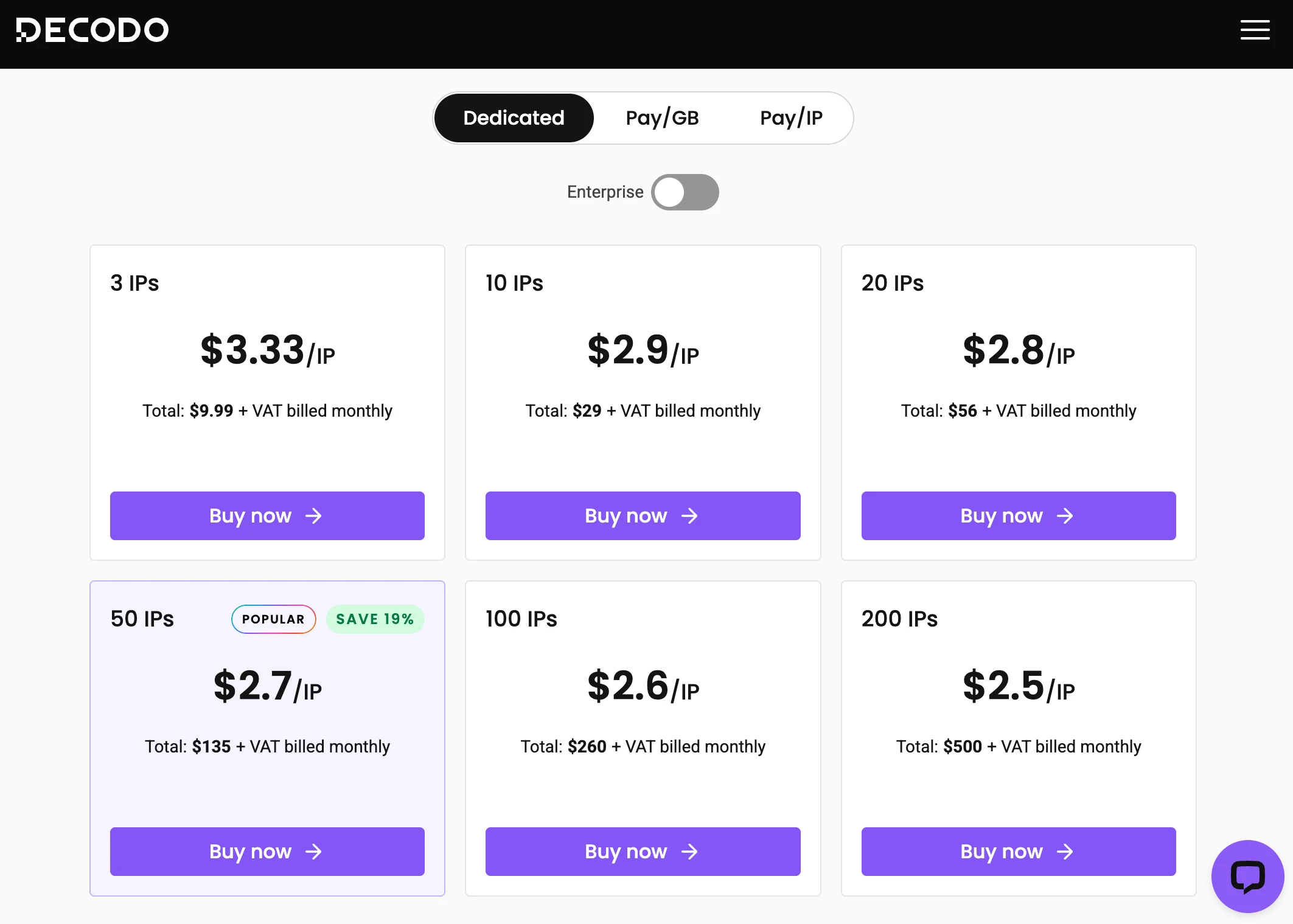
| 3 IPs | $3.33 | $9.99 |
| 10 IPs | $3.00 | $30.00 |
| 25 IPs | $2.80 | $70.00 |
| 50 IPs (popular) | $2.70 | $135.00 |
| 100 IPs | $2.50 | $250.00 |
| 500 IPs | $2.25 | $1,125.00 |
| 1,000 IPs | $2.10 | $2,100.00 |
| 2,000 IPs | $2.00 | $4,000.00 |
ISP Proxy Pricing — Pay per GB:
| GB | $/GB | Monthly Total |
|---|---|---|
| 1 GB | $3.00 | $3.00 |
| 5 GB | $2.50 | $12.50 |
| 100 GB | $2.00 | $200.00 |
The per-IP model is better if you need a fixed number of persistent identities. The per-GB model makes more sense for high-bandwidth tasks where you do not need IP persistence.
Mobile Proxies
Decodo's mobile proxy network covers 10M+ IPs across 160+ locations, with 700+ mobile carriers and support for 3G, 4G, and 5G connections. The largest pools are concentrated in key markets: US (3.9M), Germany (1.2M), UK (940K), and India (720K).
Mobile IPs carry an inherently high trust score with most platforms because they come from real mobile carrier blocks. This makes them the most effective proxy type for mobile app testing, mobile-specific scraping, and social media automation where desktop fingerprints are flagged.
Session handling works similarly to residential proxies — you can rotate per request or maintain sticky sessions, depending on your use case.
Mobile Proxy Pricing (pay per GB):
| Plan | $/GB | Monthly Total |
|---|---|---|
| 2 GB | $3.75 | $7.50 |
| 8 GB | $3.50 | $28.00 |
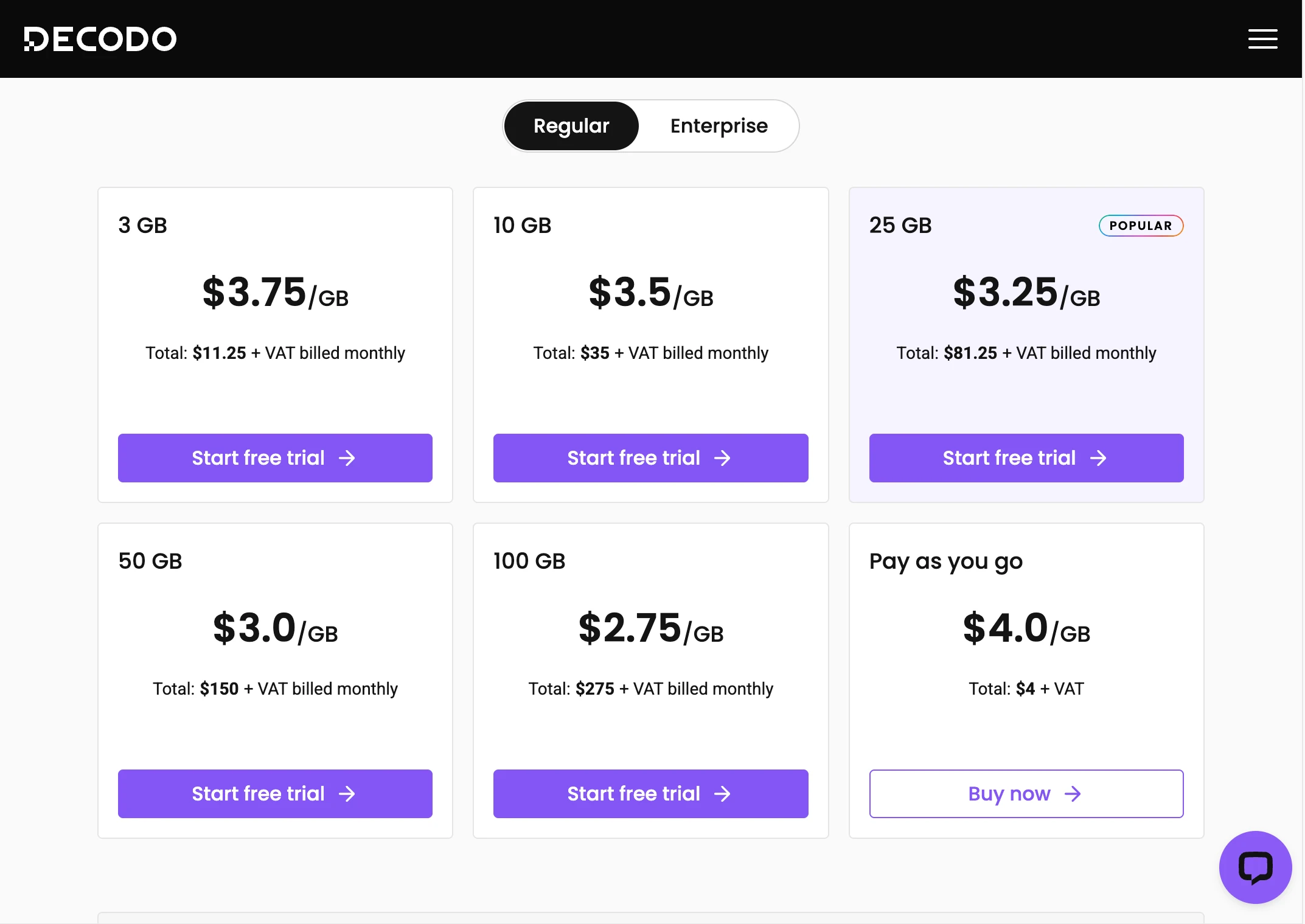
| 25 GB | $3.25 | $81.25 |
| 50 GB (popular) | $3.00 | $150.00 |
| 100 GB | $2.75 | $275.00 |
| 250 GB | $2.50 | $625.00 |
| 500 GB | $2.25 | $1,125.00 |
| Pay-as-you-go | $4.00 | per GB |
The 50 GB plan at $3.00/GB is where mobile proxies start making sense financially for regular workflows. Casual or testing use at the 2 GB entry level works out reasonably at $7.50/month.
Datacenter Proxies
Datacenter proxies are the fastest and cheapest option Decodo offers. They do not originate from real ISPs or residential connections, so they are more easily detected by sophisticated anti-bot systems, but they deliver excellent throughput for high-volume tasks where speed matters more than stealth.
Decodo has 500K+ shared and dedicated datacenter IPs. For high-volume datacenter proxy workloads, the per-GB pricing becomes very attractive at scale — $0.38/GB at 10 TB/month is difficult to beat.
Datacenter Proxies — Pay per GB (shared):
| Plan | $/GB | Monthly Total |
|---|---|---|
| 10 GB | $0.60 | $6.00 |
| 50 GB | $0.57 | $28.50 |
| 100 GB | $0.54 | $54.00 |
| 250 GB (popular) | $0.51 | $127.50 |
| 500 GB | $0.48 | $240.00 |
| 1,000 GB | $0.45 | $450.00 |
| 3,000 GB | $0.41 | $1,230.00 |
| 10,000 GB | $0.38 | $3,800.00 |
Datacenter Proxies — Pay per IP (shared):
| IPs | $/IP | Monthly Total |
|---|---|---|
| 100 IPs | $0.035 | $3.50 |
| 500 IPs (popular) | $0.031 | $15.70 |
| 1,000 IPs | $0.030 | $29.70 |
| 4,000 IPs | $0.026 | $105.00 |
| 15,000 IPs | $0.020 | $300.00 |
Dedicated Datacenter IPs:
| IPs | $/IP/mo | Monthly Total |
|---|---|---|
| 3 IPs | $1.85 | $5.55 |
| 10 IPs | $1.75 | $17.50 |
| 25 IPs | $1.65 | ~$41.25 |
One limitation worth noting: dedicated datacenter IPs are US-only. If you need dedicated datacenter IPs in European or Asian locations, you will need to look at other providers.
Site Unblocker and Web Scraping API
Site Unblocker is Decodo's managed scraping layer. It handles automatic IP rotation, CAPTCHA solving, browser fingerprinting, and JavaScript rendering in a single API call. Pricing starts at $0.95 per 1,000 requests, making it cost-effective for accessing heavily protected sites without building custom rotation logic.
Web Scraping API is a newer addition. It targets structured data extraction from specific platforms — eCommerce sites, search engine results, social media, and YouTube. Pricing starts at $0.09 per 1,000 requests, which is meaningfully cheaper than comparable products from Bright Data. For a detailed breakdown, see the Decodo Scraping API review.
Both products sit on top of Decodo's residential proxy infrastructure, so they inherit the same IP quality and geographic coverage. They are worth evaluating if you are currently managing rotation logic yourself and want to reduce infrastructure overhead.
Features Deep Dive
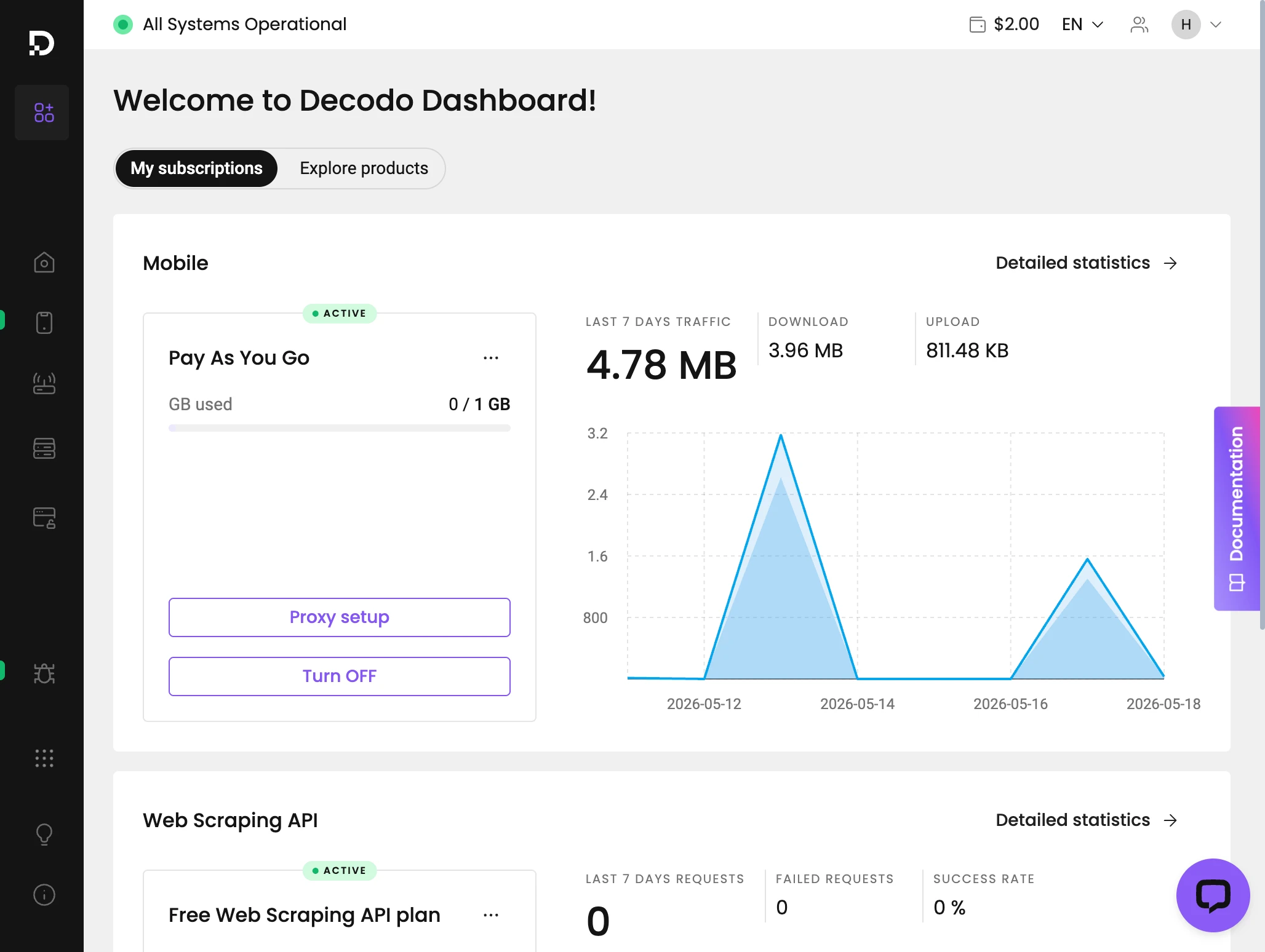
Dashboard
The Decodo dashboard is well-organized. After logging in, you see separate tabs for each proxy product — residential, ISP, mobile, datacenter — along with usage statistics and billing. Proxy endpoint credentials are displayed clearly, and you can generate new credentials without contacting support.
Usage graphs update in near real-time, so monitoring bandwidth consumption across sub-users is straightforward.
Sticky Sessions
Residential and mobile proxy sticky sessions last up to 30 minutes. You control the session ID via the session parameter in the proxy string. When you change the session ID, you get a new IP. When you keep it the same, the same IP is maintained until the 30-minute window expires or the connection is dropped.
Sub-User Management
Admins can create sub-users and allocate a fixed bandwidth quota or a specific number of IPs to each one. This is genuinely useful for agencies managing client accounts or development teams where different projects need isolated proxy pools with separate usage tracking.
Browser Extensions
Chrome and Firefox extensions let you switch IPs without touching any configuration files. You can set a custom session duration, filter by country, and the extensions include WebRTC leak prevention — which matters for account management tasks where IP consistency needs to match browser fingerprint data.
X Browser
X Browser has been discontinued. Decodo previously offered a built-in antidetect browser called X Browser, which allowed users to manage multiple browser profiles with unique fingerprints. It is no longer available on the Decodo platform.
Most other reviews of Decodo still list X Browser as an active feature — it has been removed. If you need antidetect browser functionality alongside Decodo proxies, you will need a separate tool. AdsPower and Incogniton both integrate directly with Decodo proxy credentials. For a broader comparison, see the best antidetect browsers guide.
Ease of Use
Getting started with Decodo takes under 10 minutes. After creating an account and purchasing a plan, the dashboard presents your proxy endpoint, port, username, and password. You can copy these directly into any application or configure whitelisted IPs as an alternative to credential-based auth.
The documentation is thorough and includes code examples in Python, Node.js, PHP, and cURL. For teams using automation tools, there are integration guides for n8n, LangChain, and the MCP Server.
Proxy Checker is a free tool on the Decodo website that lets you test up to 10,000 proxies at once — useful for validating proxy lists from any provider, not just Decodo. It checks response time, anonymity level, and whether the proxy is live.
The overall learning curve is low. The dashboard avoids unnecessary complexity, and the support team is available 24/7 to walk through setup if needed.
Decodo Pricing: Is It Worth It?
Decodo's value depends on your volume. The pricing structure rewards commitment — the per-GB rate for residential proxies drops from $3.75 at 3 GB to $2.00 at 1,000 GB. For teams running consistent monthly workloads at 50 GB or more, the unit economics are competitive.
For low-volume users, the math is less favorable. The PAYG residential rate at $8.50/GB is one of the higher rates in the market. The 3 GB entry plan at $11.25/month is a reasonable way to start testing, but if you only need a gigabyte or two occasionally, there are cheaper options.
Datacenter proxies are where Decodo is most price-competitive outright — $0.38/GB at 10 TB/month is genuinely difficult to find elsewhere at comparable IP quality.
Payment methods accepted: credit cards, PayPal, Alipay, Google Pay, Apple Pay, and cryptocurrency. Note that crypto payments are not available for ISP per-IP and datacenter per-IP plans, and the 14-day money-back guarantee does not apply to crypto transactions.
On the money-back guarantee: the 14 days is real, but the conditions matter. You must have used less than 20% of your purchased bandwidth. If you buy a 100 GB plan and use 25 GB testing it, you are past the threshold and no longer eligible. Read the terms before purchasing a large plan.
Customer Support
Decodo's 24/7 live chat is the most consistently praised aspect of the service across independent reviews. Response times are fast — under 2 minutes during business hours, and still reasonable at off-peak times. The support team can handle both billing questions and technical issues like proxy configuration for specific use cases.
Beyond live chat, Decodo offers:
- Documentation: Comprehensive knowledge base covering all proxy types, integration guides, and troubleshooting
- YouTube channel: Video tutorials for common setup scenarios and platform-specific use cases
- GitHub: Code samples and integration examples in multiple languages
- Discord community: Active community where users share configurations and troubleshooting tips
The combination of 24/7 live chat plus community channels means you have multiple routes to resolution. This is noticeably better than some competitors that restrict live chat to business hours or higher-tier plans.
Who Should Use Decodo?
Best for:
- Web scraping teams running 10–200 GB/month of residential proxy traffic — the per-GB rates at mid-tier volumes are competitive
- Social media and account managers who need ISP proxies with consistent IP identity and high uptime from premium ASNs
- Agencies managing multiple clients — sub-user management with per-client bandwidth allocation is genuinely useful
- Mobile app testing teams — 10M+ mobile IPs across 700+ carriers with 3G/4G/5G support covers most testing scenarios
- eCommerce and SERP data teams — the Web Scraping API at $0.09/1K requests is cost-effective for structured data pipelines
Not ideal for:
- Casual or low-volume users — the PAYG residential rate ($8.50/GB) makes sporadic use expensive
- Users needing dedicated datacenter IPs outside the US — those are US-only at Decodo
- Anyone who needs a completely unconditional money-back guarantee — the 20% usage cap means you need to test lightly before committing
- Teams that need the highest residential success rates on extremely protected targets — Bright Data and Oxylabs have stronger infrastructure for sites with advanced bot detection
Decodo vs Competitors
For a full head-to-head breakdown, see Oxylabs vs Smartproxy (Decodo). Here is a quick summary:
| Feature | Decodo | Bright Data | Oxylabs |
|---|---|---|---|
| Residential IPs | 115M+ | 150M+ | 100M+ |
| Residential entry price | $3.75/GB | ~$5.04/GB | ~$4.00/GB |
| ISP proxies | Yes (premium ASNs) | Yes | Yes |
| Mobile proxies | Yes (10M+ IPs) | Yes | Yes |
| Datacenter proxies | Yes (500K+) | Yes | Yes |
| Web Scraping API | Yes ($0.09/1K) | Yes (higher price) | Yes |
| Antidetect browser | No (X Browser discontinued) | No | No |
| 24/7 live chat | Yes | Yes | Business hours |
| HQ jurisdiction | Lithuania (non-Five Eyes) | Israel | Lithuania |
Decodo is priced below Bright Data on most proxy types and offers better entry pricing than Oxylabs for residential proxies. Where Bright Data earns its premium is primarily on success rates for heavily protected targets. For most standard scraping and automation tasks, Decodo's infrastructure is sufficient and the pricing is more accessible.
FAQs
Is Decodo the same as Smartproxy?
Yes. Decodo is the rebranded name for Smartproxy. The company rebranded in 2024. The infrastructure, pricing model, and team are the same — only the brand name changed.
Does Decodo offer a free trial?
Decodo offers a 3-day free trial with 100 MB of residential proxy traffic. No credit card is required in most cases. This is sufficient for basic integration testing but not for meaningful performance benchmarking at scale.
What is the Decodo money-back guarantee?
Decodo offers a 14-day money-back guarantee, but it comes with a condition: you must have used less than 20% of your purchased bandwidth. Cryptocurrency payments are excluded from refund eligibility.
Does Decodo work with antidetect browsers?
Yes. Decodo proxy credentials work with AdsPower, Incogniton, MuLogin, and other third-party antidetect browsers. Note that X Browser — Decodo's previously built-in antidetect browser — has been discontinued and is no longer available.
Which proxy type from Decodo is best for social media automation?
ISP proxies (static residential) are the best choice for social media proxy tasks. They provide a permanent IP from a real ISP with 99.99% uptime, meaning your accounts maintain a consistent IP identity rather than rotating through different addresses, which platforms treat as suspicious.
Can I use Decodo for SERP scraping?
Yes. Both residential proxies and the dedicated Web Scraping API support SERP data extraction. For structured search result data at scale, the Web Scraping API at $0.09/1K requests is more efficient than managing proxy rotation manually.
Is Decodo based in the US?
No. Decodo is headquartered in Vilnius, Lithuania. Lithuania is not part of the Five Eyes, Nine Eyes, or Fourteen Eyes intelligence-sharing alliances, which some users consider when choosing a proxy provider for sensitive data workflows.
Final Verdict: Is Decodo Worth It?
Decodo earns its 4.7/5 rating by doing the fundamentals well across a wide product range. The residential pool is large enough for most scraping needs, ISP proxies are well-sourced and reliable, mobile proxies cover a broad carrier network, and datacenter pricing is competitive at volume. The inclusion of X Browser and the built-in tools like the proxy checker and browser extensions add practical value beyond just selling IPs.
The honest caveats: entry pricing for residential PAYG is high, dedicated datacenter IPs are US-only, and the money-back conditions require careful reading. If you are buying a plan above 10 GB for residential or 50 IPs for ISP, the per-unit pricing is fair relative to the quality. Below that threshold, compare alternatives carefully.
For teams already committed to a proxy workflow with moderate to high volume, Decodo is a well-maintained, reliable choice with good support.
Overall: 4.7 / 5