
Apify Review 2026: Pricing, Pros Cons & Verdict

Most web scraping tools fall into one of two categories: raw APIs that give developers full control, or point-and-click tools that lack flexibility. Apify sits in a third category — a full-scale cloud platform with 1,500+ ready-made scrapers called Actors, built-in proxy infrastructure, dataset storage, and scheduling, all in one place.
If you are an SEO team that needs Google SERP data, a data analyst who wants Instagram or TikTok data without writing a scraper from scratch, or a developer building an AI data pipeline, Apify has a pre-built Actor for your use case. With over 127,000 users on its Google Search Results Scraper alone, and enterprise clients including Groupon, Intercom, and the EU Commission, this is not a niche tool.
This Apify review covers what the platform actually does, how the pricing works, which Actors are worth using, and who it makes sense for compared to simpler alternatives like Firecrawl.
Quick Verdict
Rating: 4.5 / 5
Pros:
- 1,500+ pre-built Actors covering every major platform and data source
- Google SERP scraping with AI Mode, AI Overviews, PAA, and cross-platform AI comparison (Perplexity, ChatGPT, Copilot, Gemini)
- SOC 2 certified and GDPR compliant — suitable for enterprise use
- Free tier with $5 credit, no credit card required
- Integrates with Zapier, n8n, Make, Slack, Google Sheets, Pinecone, and MCP clients
- Open-source Crawlee library for custom scraping in Python and JavaScript
Cons:
- Pricing model (compute units + pay-as-you-go) can be difficult to estimate upfront
- Free plan blocks access after $5 credit is consumed until next billing cycle
- Not ideal for developers who just want a one-call scraping API without managing Actors
- Residential proxy rates ($8/GB on Starter) are not the cheapest on the market
- Some popular Actors are third-party maintained — quality and update frequency vary
What Is Apify?
Apify is a cloud platform for web scraping and browser automation, built around the concept of Actors — containerized, cloud-deployed programs that extract data from websites or automate browser tasks. Actors can be pre-built from the Apify Store or custom-built using the Apify SDK.
Beyond just running scrapers, Apify provides the full infrastructure layer around them:
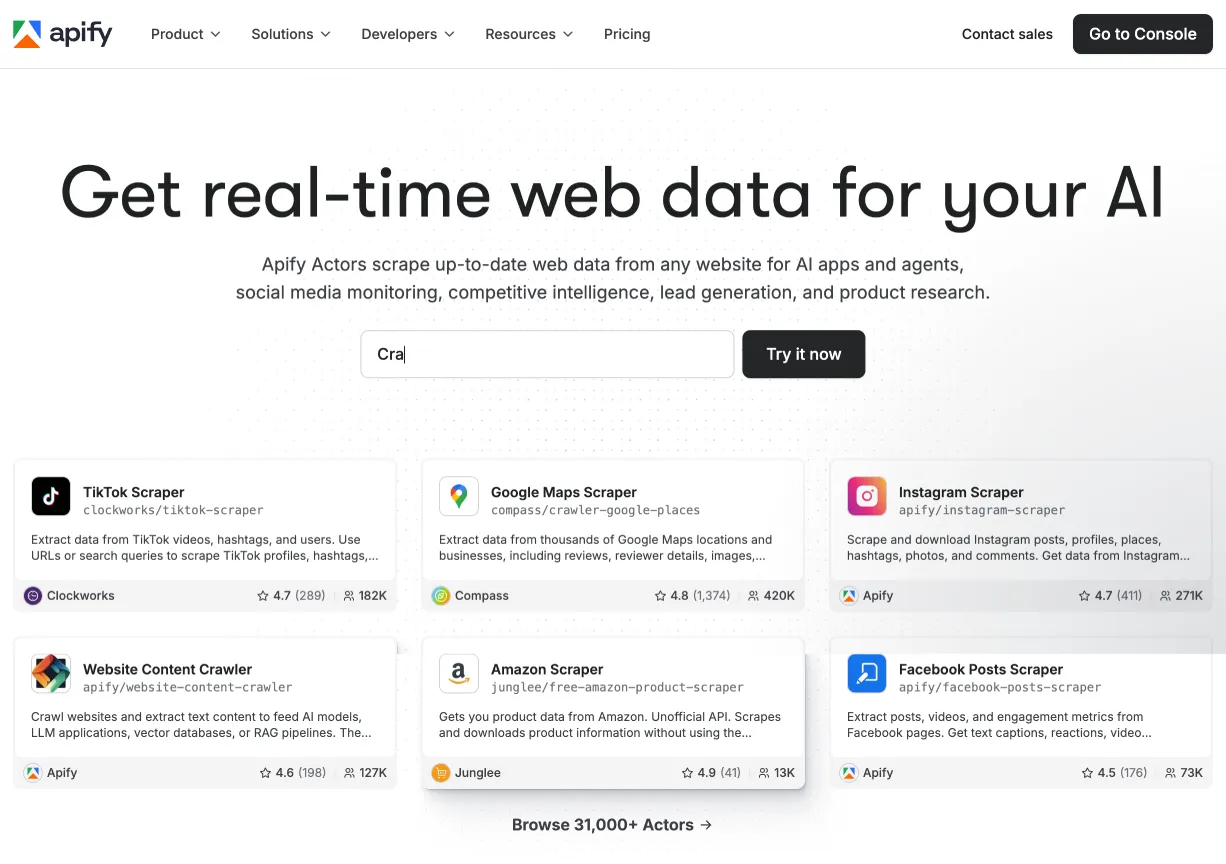
- Apify Store: A marketplace with 1,500+ (the store lists 31,000+ including all community contributions) pre-built Actors for platforms like Google, TikTok, Instagram, Amazon, LinkedIn, and more
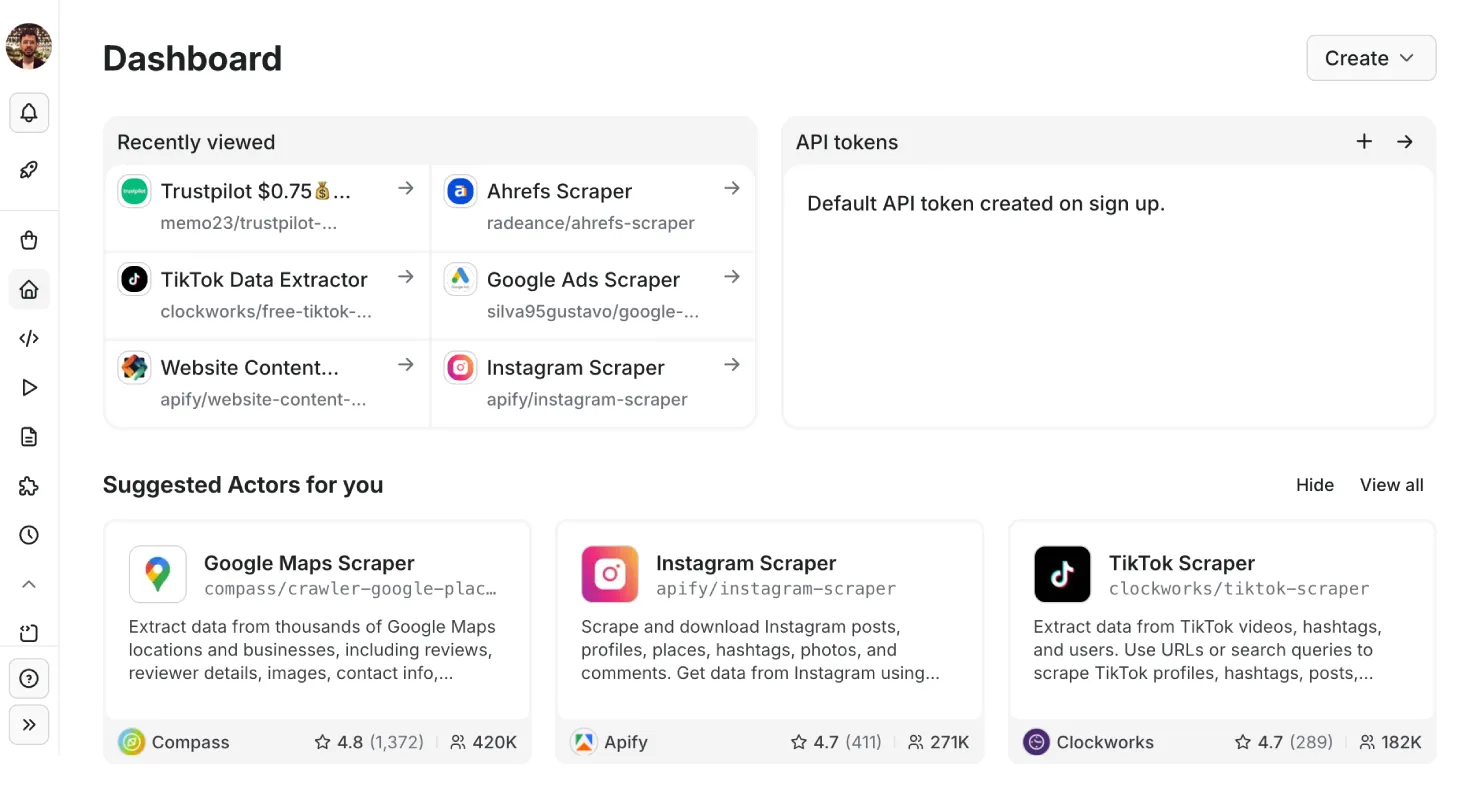
- Apify Console: A web dashboard for running Actors, scheduling tasks, monitoring runs, and browsing extracted datasets
- Built-in proxy network: Residential proxies, datacenter proxies, and a dedicated SERP proxy layer
- Dataset storage: Cloud-based storage for scraping output, queryable via API
- Scheduling and webhooks: Cron-based scheduling and webhook triggers for integrating Actors into broader data pipelines
- Python and Node.js SDKs: For developers building custom Actors or integrating Apify into existing codebases
The primary use cases break down into four broad areas:
| Use Case | Example |
|---|---|
| AI data pipelines | Feeding LangChain or LlamaIndex with real-time web content |
| Lead generation | Extracting business contacts from Google Maps or LinkedIn |
| Competitive intelligence | Monitoring competitor pricing across eCommerce platforms |
| Social media monitoring | Tracking brand mentions across TikTok, Instagram, and X |
Apify is SOC 2 certified, GDPR compliant, and operates at 99.95% uptime. Notable customers include Groupon (2x leads using Apify data), Intercom (28M+ AI chats powered by Apify-scraped data), and the EU Commission (800+ retailers monitored for compliance).
Apify Actors — The Core Feature
An Actor is the fundamental unit of Apify. Think of it as a cloud function that handles one scraping or automation task — it has a defined input schema, runs on Apify's infrastructure, handles proxies automatically, stores output in a dataset, and can be triggered via API, schedule, or webhook.
When you use an Actor from the Apify Store, you are essentially renting a pre-built, maintained scraper. You define the input (keywords, URLs, filters), click Start, and the Actor returns structured data. No infrastructure to manage, no anti-bot logic to write.
Top Actors by User Count
| Actor | Users | Rating | Starting Price |
|---|---|---|---|
| Google Maps Scraper | 417K | 4.8 | Pay per use |
| Instagram Scraper | 270K | 4.7 | Pay per use |
| TikTok Scraper | 181K | 4.7 | Pay per use |
| Google Search Results Scraper | 127K | 4.8 | $1.80/1,000 pages |
| Website Content Crawler | 127K | 4.6 | Pay per use |
| Facebook Posts Scraper | 73K | 4.5 | Pay per use |
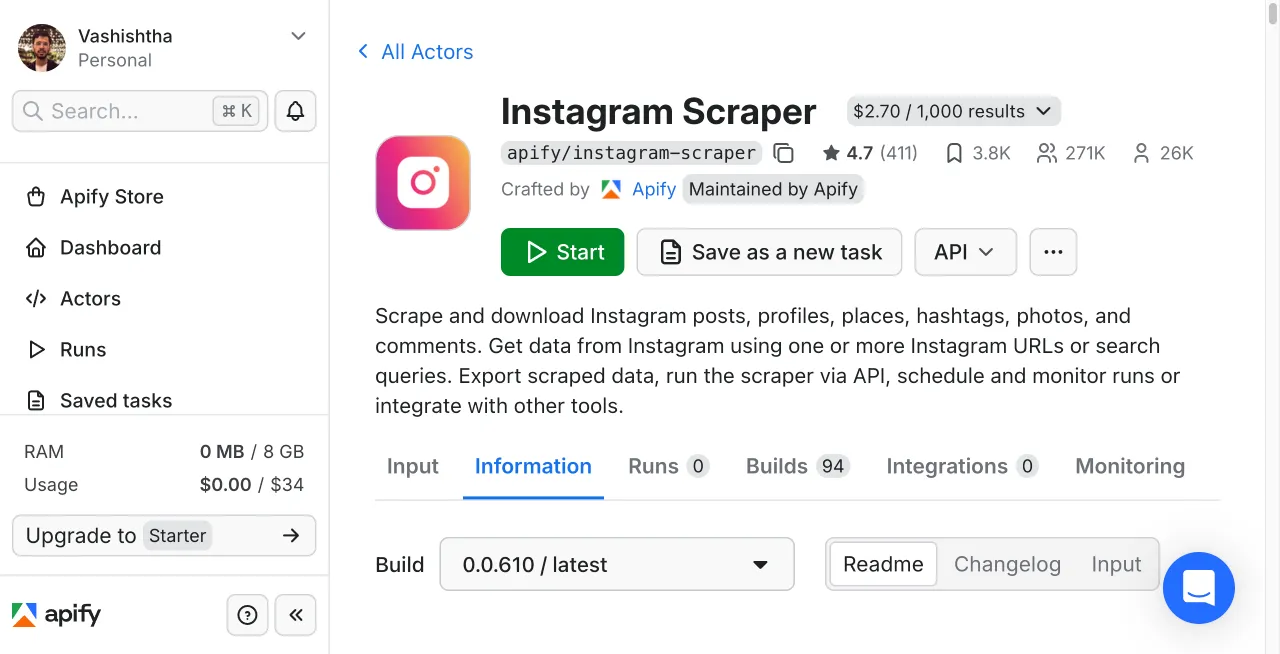
The Instagram Scraper (270K users, 4.7 rating) extracts posts, profiles, hashtags, photos, and comments using URLs or search queries. It supports scheduling, API access, and direct export to Google Sheets or data warehouses — making it one of the most widely used social media Actors on the platform.
The TikTok Scraper (181K users) covers videos, hashtags, user profiles, and engagement metrics. The Google Maps Scraper (417K users) is one of Apify's largest — it extracts business listings, reviews, contact info, opening hours, and pricing data at scale.
For AI/ML teams, the Website Content Crawler (127K users, 4.6 rating) is especially relevant — it crawls websites and formats content as clean Markdown, directly compatible with LangChain, LlamaIndex, vector databases, and RAG pipelines.
Actors are priced in one of two ways: either through Apify's compute unit consumption (billed against your plan's prepaid credit), or via a pay-per-event model where you pay a fixed rate per result or page scraped.
SERP Scraping with Apify
The Google Search Results Scraper is one of Apify's flagship Actors, with 127K total users, 4.8 rating, and 10K monthly active users. Pricing starts at $1.80 per 1,000 scraped search result pages.
What makes it stand out is the breadth of data it can extract from a single search:
Standard extraction:
- Organic results with titles, URLs, descriptions, and position
- Paid results and product ads
- People Also Ask (PAA) answers
- Related queries
- Review ratings and review counts
- Suggested results
AI search add-ons:
- Google AI Mode: Scrapes Google's dedicated AI-powered search interface — useful for AEO (Answer Engine Optimization) and GEO (Generative Engine Optimization) tracking
- AI Overviews: Extracts the AI-generated summary that appears above organic results
- Perplexity AI search: Fetches AI-generated answers using the Perplexity Sonar model for cross-platform comparison
- ChatGPT search: Pulls answers from OpenAI's search model, including
queryFanOutdata showing additional search queries the model generated - Copilot search: Microsoft Copilot results with four response modes (chat, reasoning, smart, study)
- Gemini search: Google Gemini (gemini.google.com) results, separate from standard Google Search
The ability to compare how a brand or piece of content appears across Google, Perplexity, ChatGPT, Copilot, and Gemini in a single run is valuable for SEO and content teams monitoring AI search visibility.
Business leads enrichment is an optional add-on that appends contact details — full name, work email, phone number, job title, and LinkedIn profile — to each organic result. This turns SERP data into a direct lead generation pipeline.
On the free plan, the $5 credit lets you scrape over 1,000 Google Search results without add-ons. Paid plans reduce the per-page cost further with Store discounts.
Platform Features
Scheduling
Actors can be scheduled using standard cron syntax — hourly, daily, weekly, or custom intervals. Scheduled runs execute automatically, and results are stored in the associated dataset. This is the backbone of any recurring data pipeline built on Apify.
Webhooks and API Endpoints
Every Actor exposes an HTTP API endpoint. You can trigger a run, pass input, and retrieve results programmatically using the Apify REST API. Webhooks allow you to push notifications or trigger downstream workflows when a run completes — directly compatible with Zapier, Make, and n8n.
Dataset Storage
All Actor output is stored in Apify's cloud datasets. Datasets can be exported as JSON, CSV, Excel, XML, HTML, or RSS. The Apify API provides read and write access, making it easy to pipe data to external databases, data warehouses, or BI tools.
Storage pricing (detailed):
| Storage Type | Free / Starter | Scale | Business |
|---|---|---|---|
| Dataset (timed, 1K GB-hours) | $1.00 | $0.90 | $0.80 |
| Key-value store (timed, 1K GB-hours) | $1.00 | $0.90 | $0.80 |
| Request queue (timed, 1K GB-hours) | $4.00 | $3.60 | $3.20 |
Python and Node.js SDKs
The Apify SDK is available for both Python and JavaScript/TypeScript. It integrates with Playwright, Puppeteer, Selenium, Scrapy, Cheerio, and BeautifulSoup — and with Apify's own open-source Crawlee library (23,000+ GitHub stars). Templates are available for LlamaIndex, LangChain, and all major scraping frameworks.
Integrations
Apify connects directly with:
- Automation platforms: Zapier, Make, n8n
- Data destinations: Google Sheets, Google Drive, Airbyte, Pinecone
- AI ecosystems: LangChain, LlamaIndex, MCP clients
- Communication: Slack
- Developer tools: GitHub
The MCP client integration is particularly relevant for teams building AI agents — Apify Actors can serve as data-fetching tools within an MCP workflow without any custom API code.
Apify Console
The Console is the web dashboard for managing everything: running Actors, browsing datasets, monitoring usage, configuring schedules, and reviewing billing. It is clean and functional, though the pricing model's complexity (compute units + per-event pricing + proxy costs + storage) means the billing view requires some attention to understand actual costs.
Apify Pricing
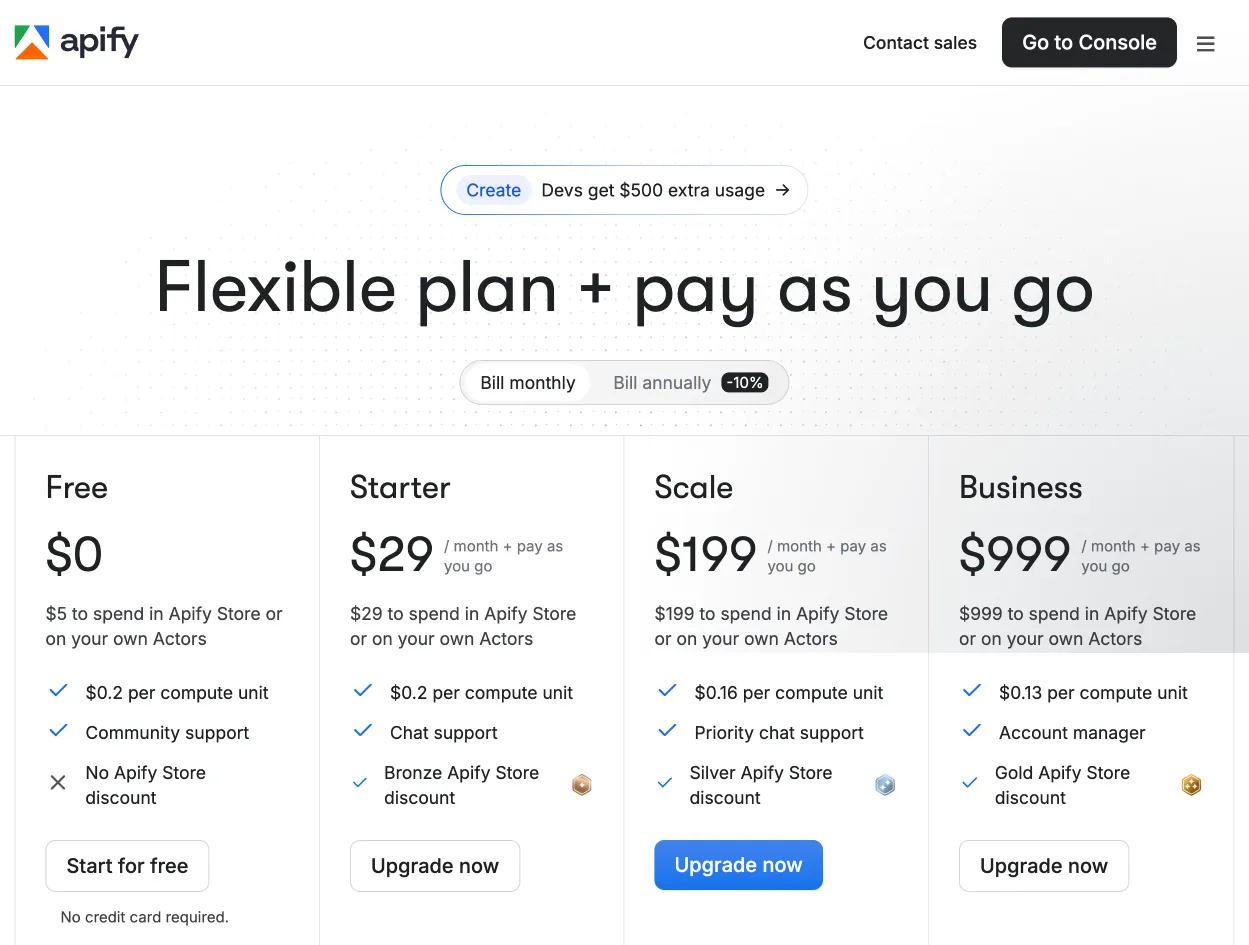
Apify uses a platform subscription + pay-as-you-go model. Each plan includes a prepaid usage credit that covers Actors, proxies, storage, and compute. If you exceed the prepaid amount, excess usage is charged at overage rates. Unused credits do not roll over.
Subscription Plans
| Plan | Monthly Price | Prepaid Credit | Actor RAM | Concurrent Runs | Support |
|---|---|---|---|---|---|
| Free | $0 | $5 | 8 GB | 25 | Community |
| Starter | $29/mo | $29 | 32 GB | 32 | Chat |
| Scale | $199/mo | $199 | 128 GB | 128 | Priority chat |
| Business | $999/mo | $999 | 256 GB | 256 | Account manager |
| Enterprise | Custom | Unlimited | Custom | Custom | Custom |
Compute Unit Pricing
| Plan | Cost per Compute Unit (1 GB RAM / hour) |
|---|---|
| Free | $0.20 |
| Starter | $0.20 |
| Scale | $0.16 |
| Business | $0.13 |
Proxy Pricing
| Proxy Type | Free / Starter | Scale | Business |
|---|---|---|---|
| Residential proxies | $8.00/GB | $7.50/GB | $7.00/GB |
| SERP proxy | $2.50/1,000 SERPs | $2.00/1,000 SERPs | $1.70/1,000 SERPs |
| Datacenter proxies | 5 IPs included | 200 IPs included (then $0.80/IP) | 500 IPs included (then $0.60/IP) |
For context on the SERP proxy rate: at the Business plan, $1.70 per 1,000 SERPs means scraping 100,000 Google search results costs $170. For teams running SERP monitoring at scale, this is competitive compared to dedicated SERP API providers.
The residential proxy rate of $8/GB on Free and Starter plans is higher than standalone proxy providers like Decodo which starts at $3.75/GB for residential. However, when using Apify Actors, the proxy is abstracted away — you pay for the overall Actor run rather than managing proxy bandwidth separately.
Add-ons
| Add-on | Price |
|---|---|
| Concurrent runs | $5 per additional run |
| Actor RAM | $1 per GB |
| Priority support | $100/month |
| Personal training | $150/hour |
Annual Discount
Annual billing saves 10% across all paid plans.
Who Is Apify For?
Best for:
- SEO teams that need ready-made SERP scrapers — the Google Search Results Scraper with AI Mode, AI Overview, and multi-platform comparison (Google, Perplexity, ChatGPT, Copilot, Gemini) covers modern search monitoring thoroughly
- Data teams who want scraping infrastructure without building it — pick an Actor, configure inputs, get structured data
- Agencies running multi-client data pipelines — scheduling, webhooks, and dataset management handle recurring jobs at scale
- AI/ML teams building RAG pipelines, AI agents, or LLM training datasets — the Website Content Crawler and MCP integration make Apify a direct data source for AI workflows
- Lead generation teams — Google Maps Scraper, LinkedIn Jobs Scraper, and business leads enrichment on SERP results cover most B2B lead sources
Not ideal for:
- Developers who want a simple scraping API — if you just need
scrape(url) → markdown, Apify's Actor model adds unnecessary complexity - Low-volume casual users — the free plan's $5 credit runs out quickly, and the Starter plan at $29/month may be more than occasional scrapers need
- Teams needing the cheapest proxy rates — Apify's residential proxy pricing is not competitive standalone; dedicated proxy providers are cheaper per GB
Apify vs Firecrawl
Both Apify and Firecrawl aim to give developers clean, usable web data — but their approaches are fundamentally different.
| Feature | Apify | Firecrawl |
|---|---|---|
| Core model | Platform with pre-built Actors | Single-call scraping API |
| Pre-built scrapers | 1,500+ Actors for specific platforms | No — you provide the URL |
| SERP scraping | Yes, dedicated Actor with AI Mode | Basic — requires custom setup |
| Infrastructure | Fully managed cloud platform | Managed API service |
| Open-source | Crawlee library (23K GitHub stars) | Yes (open-source core) |
| Best for | Teams wanting ready-made data pipelines | Developers wanting fast, clean scraping |
| Pricing model | Subscription + compute units + pay-as-you-go | Credits-based per URL scraped |
| AI integration | LangChain, LlamaIndex, MCP via Actors | Native AI extraction modes |
| Learning curve | Moderate (Actor model, CU pricing) | Low (one endpoint) |
| Social media data | Yes (Instagram, TikTok, etc.) | No pre-built social scrapers |
When to choose Apify: You need structured data from specific platforms (Google, Instagram, Amazon, TikTok), want SERP data with AI search visibility, or need a full data platform with scheduling, storage, and monitoring.
When to choose Firecrawl: You want to scrape arbitrary URLs and get clean markdown back with minimal setup — especially for feeding LLMs or building AI apps where speed and simplicity matter more than platform-specific structure.
The two tools are complementary more than competitive. Many teams use Firecrawl for general scraping and Apify for platform-specific structured data.
FAQs
Is Apify free to use?
Yes. Apify offers a free plan with $5 in platform credits and no credit card required. The free plan includes 8 GB Actor RAM, 25 concurrent runs, access to Apify Store Actors, and community support. When the $5 credit is consumed, access to platform services is blocked until the next monthly cycle. Paid plans start at $29/month.
What are Apify Actors?
Actors are cloud-deployed programs that run on Apify's infrastructure. They can be scrapers, automation scripts, or data processors. When you run an Actor, it handles its own proxy rotation, browser automation, output storage, and error retries. Actors in the Apify Store are pre-built for specific platforms — you configure inputs and get structured data without writing code.
How much does Apify cost?
Apify's paid plans start at $29/month (Starter), which includes $29 in prepaid platform credit. Scale is $199/month and Business is $999/month. All plans are pay-as-you-go beyond the prepaid credit. Compute units cost $0.20/CU on Free and Starter, dropping to $0.16 on Scale and $0.13 on Business. SERP proxy rates range from $2.50 to $1.70 per 1,000 SERPs depending on the plan.
Can Apify scrape Google Search results?
Yes. The Google Search Results Scraper Actor (127K users, 4.8 rating) extracts organic results, paid results, AI Mode, AI Overviews, People Also Ask, related queries, and review data from Google SERPs. It also supports cross-platform AI search comparison with Perplexity, ChatGPT, Copilot, and Gemini. Pricing starts at $1.80 per 1,000 pages scraped.
Is Apify worth it for SEO and data teams?
Yes, for most SEO and data teams, Apify is worth it. The Google Search Results Scraper alone — covering organic results, AI Overviews, People Also Ask, and cross-platform AI search (Perplexity, ChatGPT, Copilot, Gemini) — delivers data that would take significant engineering effort to replicate. Teams that need recurring, structured data from specific platforms (Google, Instagram, TikTok, Amazon) will recover the cost quickly. Casual or low-volume users may find the free credit too limited and the Starter plan overpriced for occasional use.
Is Apify better than Firecrawl?
It depends on the use case. Apify is better for teams that need structured data from specific platforms — Google, Instagram, TikTok, Amazon — without building scrapers from scratch. Firecrawl is better for developers who want a fast, simple API to extract clean content from arbitrary URLs, especially for LLM and AI use cases. Apify has a steeper learning curve and more complex pricing, but far more pre-built data coverage.
Final Verdict: Is Apify Worth It for Data Teams?
Apify earns its 4.5/5 rating by solving a real problem: most teams need data from specific platforms, not general-purpose scraping infrastructure. The 1,500+ pre-built Actors eliminate the need to build and maintain scrapers for Google, Instagram, TikTok, Amazon, and dozens of other platforms.
The Google Search Results Scraper alone — with its AI Mode, AI Overview tracking, and cross-platform comparison across Perplexity, ChatGPT, and Copilot — makes Apify a compelling tool for any SEO or content team tracking AI search visibility in 2026.
The honest limitation: pricing complexity. Compute units, per-event Actor pricing, proxy costs, storage, and overage charges require careful planning to avoid unexpected bills. Teams with predictable workloads will find it manageable; casual or experimental users will find the free credit runs out faster than expected.
For data teams, agencies, and AI/ML engineers who want a complete scraping platform rather than a single API endpoint, Apify is the most feature-complete option available.
Overall: 4.5 / 5